English

Views: 0 Author: Site Editor Publish Time: 2026-07-17 Origin: Site
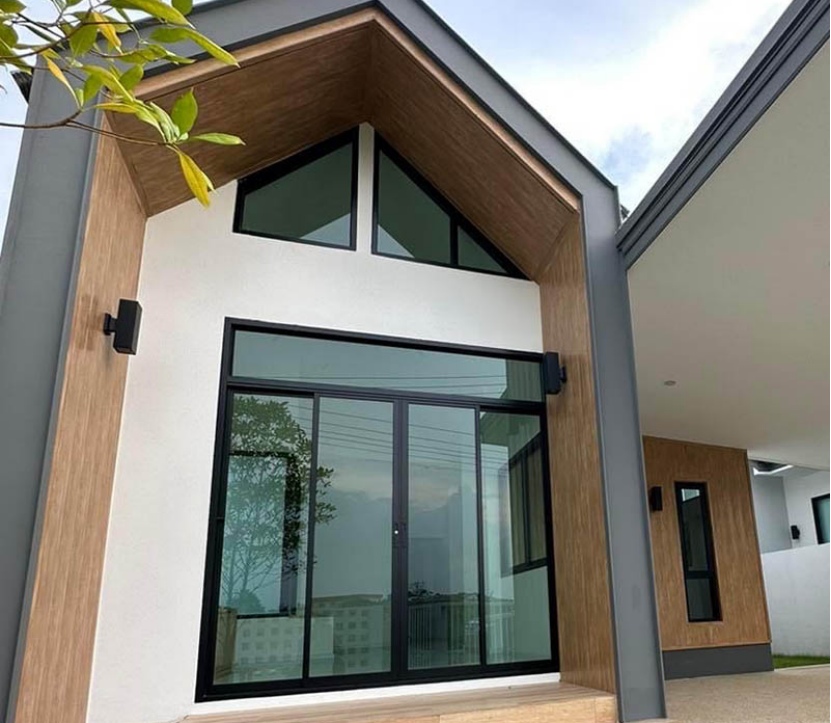
ASA is considered a third generation WPC because it closes two gaps that second-generation co-extruded WPC has not fully solved: extreme UV/color stability under sustained exposure, and fire performance that standard ASA co-extrusion does not achieve on its own. This second point needs a precise clarification, because it is where marketing language and test data most often diverge: plain ASA co-extrusion, without a dedicated flame-retardant formulation, does not reach Class B under EN 13501-1. Reaching that rating requires a specific fire-retardant formulation built into the ASA layer — which is exactly the approach behind Mexytech's NovAScend series, engineered to reach Class B under EN 13501-1 (report SDHL250200203201HI) without the flexural-strength penalty that heavy flame-retardant loading normally imposes on a wood-fiber-core WPC panel. ASA-capped panels with this formulation have also measured Grade 4 color fastness after 3000 hours of accelerated UV aging (report SDHL2407013318HI). "Third generation" describes a measurable jump in outdoor performance, not a marketing generation label invented for this article — and it is not a formal classification defined by any ISO standard.
Conventional outdoor materials — timber, basic PVC, uncapped composite — share a common failure pattern under prolonged sun and rain exposure: fading, moisture absorption, surface staining, and progressive material degradation. Wood-plastic composite (WPC) technology has evolved specifically to address this pattern, through successive changes to both the core material and the surface protection layer.
ASA is considered a third-generation WPC because it combines a composite core with a more advanced ASA co-extruded surface, engineered specifically for outdoor durability, UV stability, and long-term color retention. The distinction matters for buyers: "third generation" is a product-development description used across the industry to mark a real jump in outdoor performance — it is not a formal material classification defined by ISO or any other standards body. The performance claim behind the label, however, is verifiable through third-party test reports, which is the basis for the comparison below.
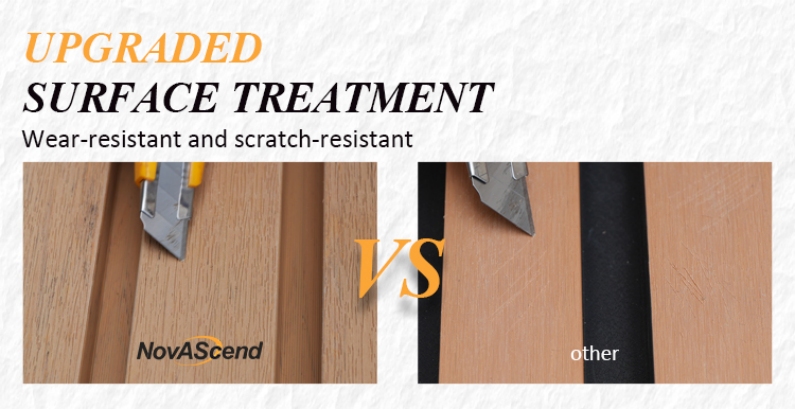
The generational progression of WPC represents a continuous evolution in both material structure and surface technology. The fundamental change across generations is not cosmetic — it is a shift toward progressively more capable protective materials at the surface, where nearly all outdoor degradation actually originates.
WPC Generation | Typical Structure | Main Improvement | Common Limitation | Verified Data |
First generation | Uncapped wood-plastic composite | Low maintenance, resistant to rot and insects | Greater exposure to fading, staining, and moisture absorption | Untreated WPC surfaces typically show visible fading and chalking within 1-2 years of full outdoor exposure |
Second generation | WPC core with a co-extruded polymer cap | Better stain, scratch, and moisture resistance | Outdoor color and weather stability depend heavily on the specific cap formulation | 3000h UV photoaging on co-extruded WPC decking confirms materially reduced fading vs. uncapped WPC (SDHL2311020050HI) |
Third generation | Composite core with an ASA co-extruded surface | Stronger UV resistance, weatherability, and long-term color stability; fire performance when formulated with a dedicated flame-retardant system | Higher initial cost, greater dependence on manufacturing and co-extrusion quality; standard ASA alone does not reach Class B without the added formulation | 3000h UV aging: Grade 4 color fastness (SDHL2407013318HI); EN 13501-1 Class B fire rating achieved specifically with a flame-retardant ASA formulation such as Mexytech's NovAScend (SDHL250200203201HI); freeze-thaw resistance passed with no delamination (SDHL250601030601HI) |
The critical distinction between second and third generation is not that ASA is simply "more weather resistant" in a general sense — co-extruded WPC has already made large gains over uncapped WPC. The distinction is that ASA closes two specific, harder problems: sustained UV/color stability at the upper end of exposure severity, and — when formulated for it — fire performance that does not require sacrificing structural strength the way flame-retardant-loaded standard WPC formulations do. That second point is formulation-dependent, not automatic: it is worth being clear that plain ASA capping does not by itself deliver a Class B fire rating.
ASA — acrylonitrile styrene acrylate — is an engineering-grade thermoplastic recognized for its outdoor weatherability. It did not originate in the building materials industry: ASA has been used for decades in automotive exterior components (grilles, mirror housings, trim) specifically because those parts must retain color and mechanical integrity after years of continuous outdoor UV exposure, temperature cycling, and weather contact — a demand profile close to what exterior building cladding faces. Its adoption in WPC co-extrusion carries that same performance requirement over to decking, cladding, and fencing applications.
In the co-extrusion process, the composite core and the ASA surface layer are formed together in a single extrusion pass:
· The composite core provides shape, rigidity, and the cost efficiency that makes WPC commercially viable
· The ASA layer forms a protective outer shell wrapped around the panel surface
· The surface can be finished with wood-grain texture, matte finishing, and a range of colors, independent of the core material's natural appearance
Because ASA is a distinct engineering polymer rather than a modified core-material additive, its protective performance does not depend on how much flame retardant or UV stabilizer is loaded into the wood-fiber core itself — a structural advantage explained further below.
· Shields the underlying composite from UV radiation, reducing the exposure that drives fading and chalking in the core material
· Reduces fading, chalking, cracking, and surface delamination caused by cumulative weather exposure — confirmed by 3000-hour accelerated UV aging testing showing Grade 4 color fastness (SDHL2407013318HI)
· Improves resistance to rain, humidity, temperature swings, staining, and everyday surface wear — freeze-thaw testing on ASA cladding-grade material passed with no surface delamination (SDHL250601030601HI), and water absorption testing confirmed a low absorption rate (SDHL2408014917HI)
· Maintains more stable performance in hot, high-UV, coastal, or highly variable climates — the conditions where uncapped and standard-capped WPC are most likely to show early degradation
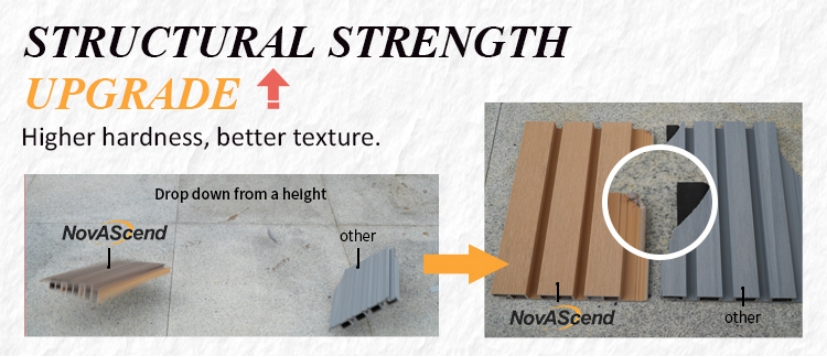
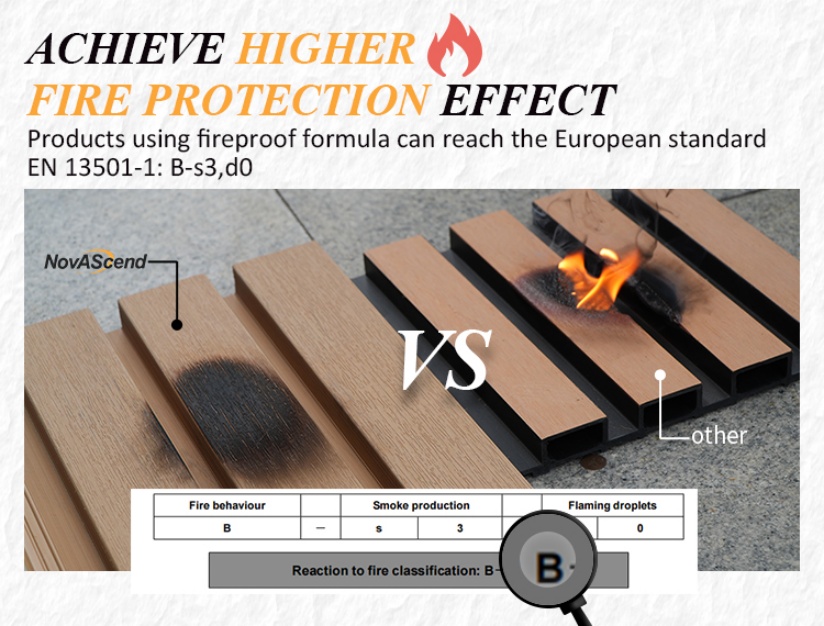
· Can improve fire performance without the usual structural trade-off — but only with the right formulation. Standard WPC typically needs heavy flame-retardant loading in the wood-fiber core to reach Class B under EN 13501-1, which reduces flexural strength and raises cost. Plain ASA co-extrusion does not solve this automatically: a standard ASA cap layer alone does not reach Class B. Reaching that rating requires a dedicated flame-retardant formulation built into the ASA layer itself. Mexytech's NovAScend series uses exactly this approach, achieving Class B under EN 13501-1 (SDHL250200203201HI) while avoiding the flexural-strength loss that heavy flame-retardant loading normally causes in a wood-fiber-core panel — because the fire-retardant chemistry sits in the ASA shell rather than diluting the composite core
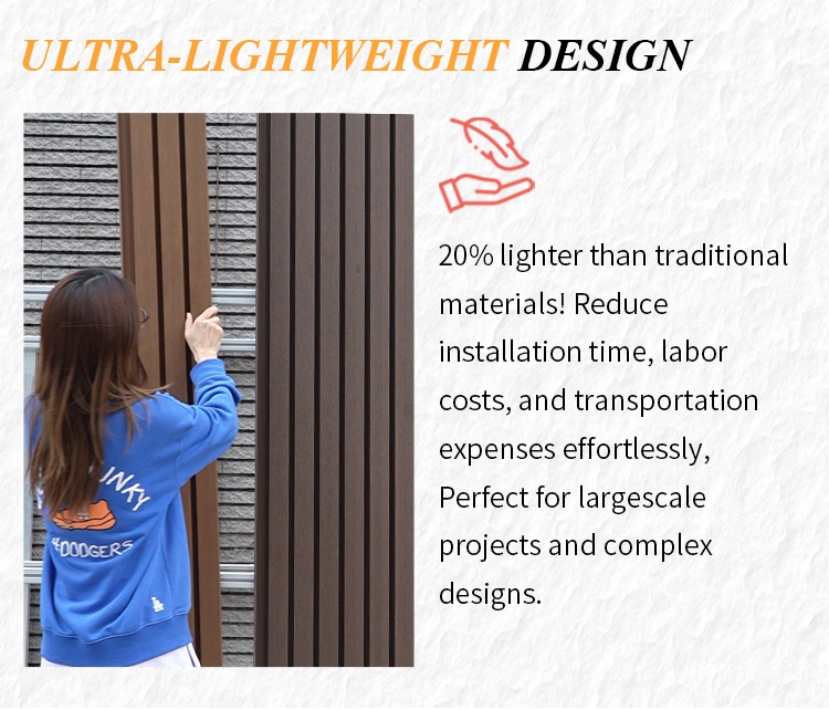
· Lower panel weight than standard WPC. Standard WPC density runs roughly 1.2-1.4 g/cm³, while ASA co-extrusion panels typically come in around 0.7-0.85 g/cm³ — a meaningful reduction for large-panel façade and fencing applications where structural load and shipping cost matter
· Superior color stability compared to uncapped WPC, verified through accelerated aging rather than claimed on the basis of formulation alone
· A convincing wood-grain finish that does not require periodic painting or staining to maintain its appearance
· A matte, natural-looking finish that avoids the glossy, plastic-like sheen common to lower-grade capped products
· Broader color range and finish consistency, supporting coordinated façade design across large projects
ASA changes both the protective performance ceiling and the design flexibility of WPC — this combination, not a single surface upgrade, is what qualifies it as a distinct generation rather than an incremental improvement. Composite wall cladding, decking, and fencing manufactured with an ASA cap layer are built specifically to extend fade resistance, weather durability, and scratch resistance beyond what standard co-extruded WPC delivers.
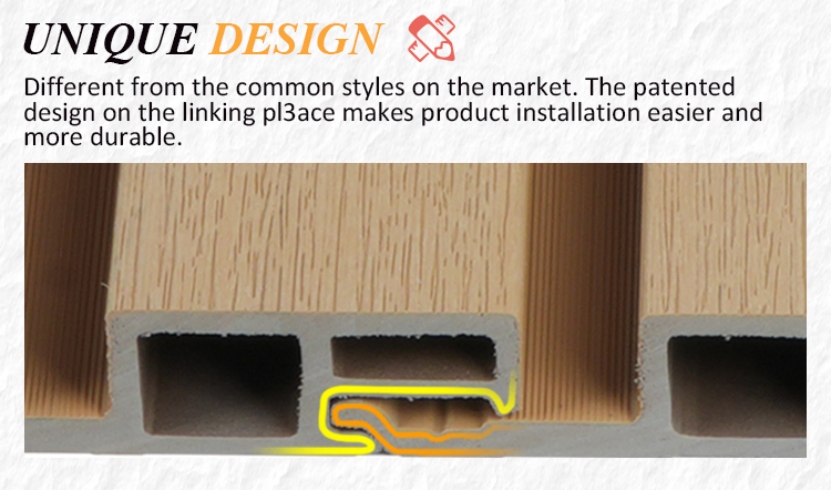
· Exterior wall cladding: long-term color consistency and façade protection across large, continuously sun-exposed surfaces
· Decking: resistance to sunlight, foot traffic wear, staining, and shifting weather conditions
· Fencing: a durable, wood-like appearance with fewer maintenance requirements over the product's service life
· Pergolas and architectural profiles: coordinated, consistent finishes across exposed exterior structural elements
Each of these applications shares the same underlying stress profile — sustained UV exposure combined with weather cycling — which is exactly the performance gap ASA co-extrusion is designed to close.
Potential advantages:
· Better UV and weather resistance, backed by 3000-hour accelerated aging data
· Longer-lasting surface appearance with less visible degradation over time
· Lower repainting or refinishing requirements across the product's service life
· Greater suitability for demanding exterior projects — high-UV climates, coastal exposure, or fire-rating-sensitive specifications
Points buyers should consider:
· Higher upfront price than basic uncapped WPC
· Performance varies by ASA formulation and cap layer thickness — not all "ASA-capped" products are formulated or manufactured to the same standard
· Poor co-extrusion quality control can reduce the expected performance benefit, regardless of the raw material used
· Not every standard residential project requires premium weather performance — for moderate climates and budget-driven projects, standard co-extruded WPC is often the more cost-effective choice
· ASA surface performance does not replace correct structural design, keel spacing, or installation practice
· Confirm ASA is genuinely used as a co-extruded cap layer, not merely referenced as an additive blended into the core material
· Request UV aging, color fastness, water resistance, impact, and fire performance test reports with specific report numbers — not summary claims
· Compare cap layer coverage, core material composition, profile structure, and panel weight across suppliers
· Verify the product is suited to the project's specific climate and application conditions
· Ask whether the fire rating was tested with the same formulation being quoted for the order — a fire-rated result requires a dedicated flame-retardant ASA formulation, not standard ASA capping by default
First-generation WPC introduced the composite core. Second-generation WPC added a protective co-extruded cap. Third-generation WPC extends that cap layer's outdoor performance further by using ASA — closing the UV/color stability gap at the high end of exposure severity, and, with the right flame-retardant formulation such as Mexytech's NovAScend, improving fire performance without the structural penalty that limits standard WPC formulations. That fire-performance gain is formulation-specific, not a default property of any ASA-capped panel — which is exactly why buyers evaluating ASA WPC should expect suppliers to support every performance claim, especially fire rating, with a specific, verifiable test report tied to the exact product being quoted.
For buyers, the value case is straightforward: stronger weatherability, more stable long-term color, longer service life between maintenance cycles, and greater design flexibility for demanding exterior applications — provided the ASA cap layer and its supporting test data are verified rather than assumed.
CTA: Learn more about Mexytech's ASA outdoor product range, or request samples and test reports for your project.
Q1: Is "third generation WPC" an official industry classification?
No. It is a product-development term used to describe a measurable performance jump — in this case, from co-extruded WPC to ASA co-extruded WPC — rather than a classification defined by ISO or any other standards body. The label is only meaningful when backed by verifiable test data, such as UV aging and fire performance reports.
Q2: How much better is ASA's UV resistance compared to standard co-extruded WPC?
Third-party testing shows ASA-capped panels maintaining Grade 4 color fastness after 3000 hours of accelerated UV aging (SDHL2407013318HI). Standard co-extruded WPC has also improved significantly over uncapped WPC in the same type of testing (SDHL2311020050HI), but ASA's engineering-grade polymer shell is specifically formulated for the upper end of UV exposure severity, which is where standard capped WPC formulations are more likely to show earlier degradation.
Q3: Does ASA WPC cost significantly more than standard co-extruded WPC?
Yes, ASA co-extrusion typically carries a higher upfront cost due to the material and manufacturing precision required. The cost difference is generally justified for high-UV climates, coastal exposure, large façade projects where panel weight matters structurally, or projects with fire-rating requirements. For moderate-climate, budget-driven residential projects, standard co-extruded WPC often remains the more cost-effective choice.
Q4: Does plain ASA co-extrusion automatically achieve a Class B fire rating?
No — this is a common misconception worth correcting directly. Standard ASA co-extrusion, without a dedicated flame-retardant formulation, does not reach Class B under EN 13501-1. That rating requires a specific fire-retardant system built into the ASA layer. Mexytech's NovAScend series is formulated this way and has achieved Class B under EN 13501-1 (SDHL250200203201HI), while avoiding the flexural-strength loss that heavy flame-retardant loading normally causes when added directly to a wood-fiber-core WPC panel. Buyers should always confirm whether the specific ASA product being quoted includes this fire-retardant formulation, rather than assuming any ASA-capped product is automatically fire-rated.
Q5: How do I verify that a supplier's "ASA WPC" product actually uses ASA as a cap layer?
Ask directly whether ASA is co-extruded as a distinct surface layer during production, or whether it is only referenced as an additive within the core compound — these are structurally very different products with different performance profiles. Request the specific UV aging, fire, and water absorption test reports for the exact product and formulation being quoted, not general marketing literature for the product line.