English

Views: 0 Author: Site Editor Publish Time: 2026-07-02 Origin: Site
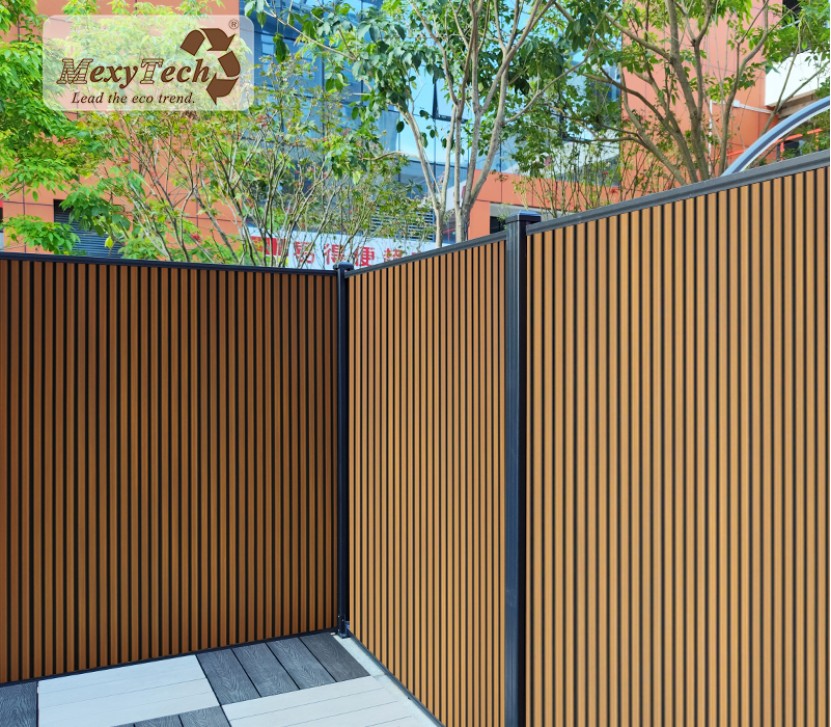
Composite privacy fences are almost always installed horizontally, and this is not simply an aesthetic choice. It is mainly the result of weight, gravity, and structural mechanics. WPC fence boards are heavy. When they are installed horizontally, the direction of gravity is the same as the direction of the mounting structure, and gravity becomes a stabilizing force.
Vertical WPC fence installation creates the opposite problem. Each board has a higher center of gravity and a longer unsupported span. The bottom rail and top rail must rely mainly on clamping force to hold the boards in place. Over time, this structure is not strong enough to resist the bending moment caused by wind load and the board’s own weight. Gravity then becomes a destructive force.
PVC or vinyl fences are different because the boards are much lighter. With a density of about 0.55–0.6 g/cm³, PVC boards create much lower self weight bending moments and lower structural stress during vertical installation. This is why vertical installation is common in vinyl privacy fences.
ASA co-extrusion composite fencing provides another option. Its density is between PVC and WPC, and its weight is only about 50% of standard WPC. It can support vertical installation while still offering a surface texture close to WPC wood grain, without the obvious plastic look often associated with vinyl fences.
In the composite privacy fence market, horizontal installation is the dominant structure. When looking at products listed as “composite privacy fence,” “WPC fence panel,” or “composite fencing,” most product images and installation instructions show boards installed horizontally. The boards are usually arranged from bottom to top, with each board overlapping or pressing against the one below it.
Vertical WPC privacy fences are rare. This does not mean manufacturers have never tried vertical composite fence installation. The reason is more practical: when WPC boards are installed vertically, structural problems such as loosening, tilting, and wind damage may appear within one to two years of use. These problems increase after sales complaints, so manufacturers and distributors naturally move toward horizontal installation systems.
The PVC or vinyl privacy fence market shows the opposite pattern. Vertical installation is the mainstream style for vinyl fences because PVC boards are light enough to make vertical installation structurally manageable.
The fundamental difference between horizontal and vertical fence installation is how gravity interacts with the board structure.
When WPC fence boards are installed horizontally, gravity pushes the boards downward in the same direction as the installation sequence. Each board is supported by the board below it and by the bottom rail. The overlapping structure allows the board’s own weight to increase the tightness of the connection rather than weaken it.
Mechanical Factor | Horizontal Installation Behavior |
Gravity direction | Gravity presses downward along the board arrangement. Each board’s weight is supported by the lower board and the bottom rail. |
Board connection | Boards overlap. The upper board presses against the lower board, making the connection tighter. |
Bending moment | The board span is relatively short because the board is supported by the left and right posts. The bending moment is lower. |
Wind load | Wind load is distributed across the panel, while the bottom rail acts as a main load bearing point. |
Long term stability | Gravity continuously compresses the overlapping joints, reducing the chance of loosening over time. |
In this structure, gravity helps the fence remain stable. The heavier the WPC board is, the more it presses into the overlapping system.
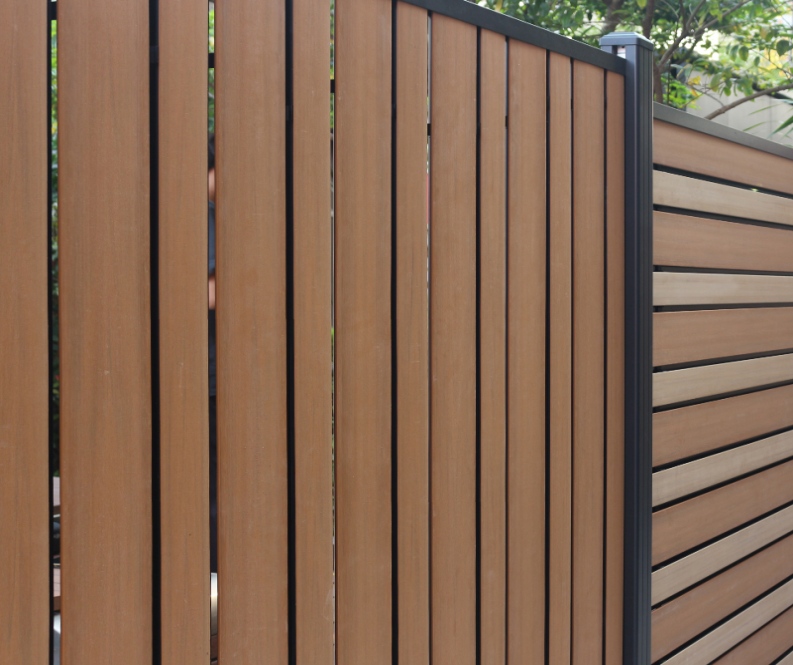
When WPC boards are installed vertically, each board is inserted into the grooves of the bottom rail and top rail. There is usually no overlapping structure between the boards. Each board becomes an independent vertical element, and its height becomes the main unsupported span.
Mechanical Factor | Vertical Installation Behavior |
Gravity direction | Gravity pulls each board downward and creates stress at the rail grooves. |
Board connection | There is no overlap. Each board is independently inserted into the top and bottom rail grooves. |
Bending moment | The board is vertical, and the board height becomes the long unsupported span. The bending moment is higher. |
Clamping force | The bottom rail and top rail rely mainly on groove friction and clamping force. For a WPC panel weighing about 45 kg, this is not enough to resist wind load and self weight bending moment over time. |
Long term stability | Gravity continues to pull downward, the grooves wear over time, and the boards may loosen, tilt, or fall off after one to two years. |
A simplified formula for the maximum bending moment is:
Mmax = w × L² / 8
In this formula, w is the load per unit length, including self weight and wind load, and L is the board height or unsupported span. Because WPC has roughly twice the density of PVC, its load w is also much higher. This means the bending moment is also much higher, and the structural risk increases accordingly.
Material density directly determines whether vertical composite fence installation is practical. WPC privacy fence boards are more than twice as dense as vinyl fence boards. This means the same vertical structure must carry more than twice the self weight bending moment.
Material | Density (g/cm³) | Approximate Weight of a 6 ft × 6 ft Panel | Vertical Bending Moment Risk | Practicality of Vertical Installation |
Standard WPC privacy fence board | 1.2–1.4 | About 45 kg | High, about twice that of PVC | Not recommended. Vertical composite fence installation has a high risk of loosening or falling off. |
PVC / Vinyl privacy fence | 0.55–0.6 | About 22 kg | Low | Mainstream. Vertical installation is an industry standard style for vinyl fences. |
ASA co-extrusion composite fencing | 0.7–0.85 | About 25–28 kg | Medium to low | Feasible. The weight is close to vinyl fence levels, so the structural risk of vertical composite fence installation is controllable. |
This is not mainly an installation skill issue. It is a material issue. The density of WPC makes vertical installation structurally risky, while the lower density of PVC makes vertical installation much easier to control.
Although horizontal WPC privacy fences are structurally stable, many buyers prefer the appearance of vertical composite fencing. Vertical lines extend upward and visually connect better with building facades. They often create a more modern, high end, and architectural look.
Horizontal WPC privacy fences create a different impression. Their lines extend sideways, which can feel more traditional, rural, or fence like. This style is stable and practical, but it does not always match the visual language of modern architecture.
In high end villas, commercial landscapes, hotels, and modern residential projects in Europe and Australia, vertical composite fencing is becoming more desirable. Buyers want the appearance of a vertical WPC privacy fence, but standard WPC composite fencing does not support this structure well. Vinyl privacy fencing can be installed vertically, but its glossy surface, limited colors, and lack of wood grain texture often create a plastic look.
This creates a market gap: buyers want the appearance of vertical WPC composite fencing, but they need the structural feasibility of vinyl fencing.
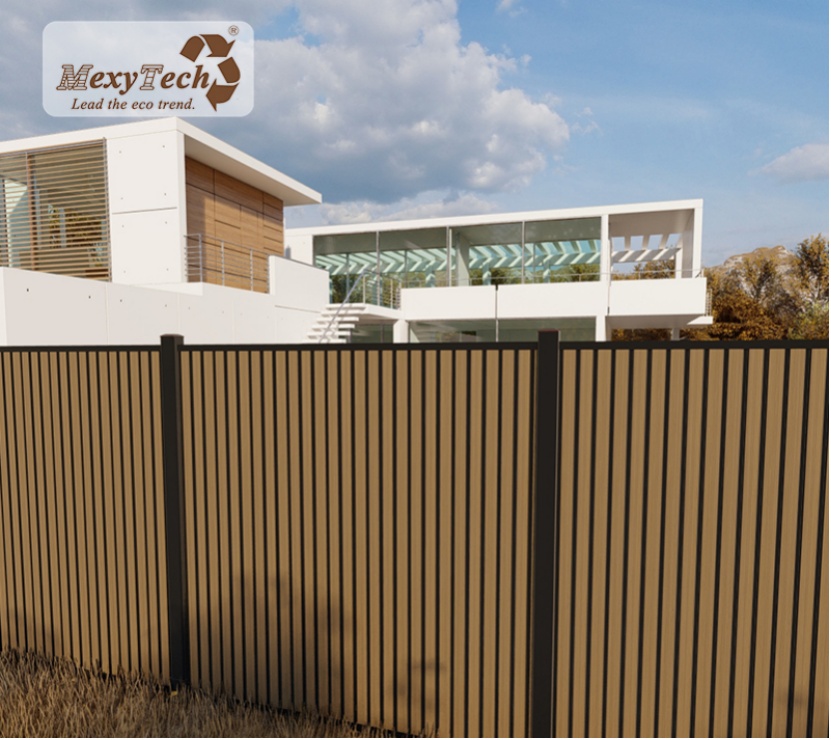
ASA co-extrusion composite fencing is designed around a different material logic. It uses an ASA outer shell over a PVC core to form a co-extruded composite board.
The ASA shell provides:
l UV stability (ASA is the standard material for automotive exterior parts, and it will not fade or whiten for 15 years)
l Wood grain texture (ASA's matte surface + double sided brushed texture eliminates the "plastic gloss" of PVC)
l Color depth (ASA's acrylic base material has far superior color retention compared to PVC, ISO 105-A02 Grey Scale 4 certified)
The key structural advantage is weight. ASA co-extrusion boards weigh about 25–28 kg per panel, which is only around 50–60% of a standard WPC privacy fence panel. During vertical installation, the self weight bending moment is much closer to that of vinyl fencing. The clamping force from the top rail and bottom rail is therefore more capable of holding the boards in place.
When paired with an aluminum frame system, including aluminum posts and aluminum rails, the overall wind resistance can reach Level 9, or about 88 km/h. This makes vertical installation structurally feasible while still maintaining a composite fence appearance.
Mexytech’s ASA co-extrusion fence is positioned in this gap: it is not simply a replacement for WPC privacy fencing, but a vertical capable composite fencing option between vinyl and WPC.
Feature | Vertical WPC Privacy Fence | Vertical Vinyl Fence | Vertical ASA Co-Extrusion Composite Fence |
Surface texture | Embossed wood grain with a matte finish | Glossy plastic surface with little or no texture | Brushed wood grain with a matte ASA surface |
Color options | Usually 3–5 limited colors | Usually white and brown | Teak, Rosewood, Antique, Golden Oak, and more |
Color fastness | May start fading after 2–3 years | May yellow or whiten after 3–5 years | ISO 105-A02 Grade 4, with long term fade resistance |
Visual effect | Strong wood like texture, but vertical composite fence installation is structurally risky | Clearly plastic looking | Close to WPC wood texture, without obvious plastic gloss |
In one sentence, the visual effect of vertical ASA composite fencing is close to the ideal appearance of a vertical WPC privacy fence, while its structural feasibility is close to that of a vertical vinyl fence. It solves two problems at the same time: WPC looks good but is not suitable for vertical installation, while vinyl can be installed vertically but often looks too plastic.
WPC fences are not installed horizontally simply because horizontal fences look better. They are installed horizontally because vertical installation creates structural risks. The density and mechanical behavior of WPC privacy fence boards make horizontal overlap the safer and more stable structure.
If a project requires vertical composite fencing, the correct selection logic should start with structure. First, confirm whether the material can support vertical installation. Then consider whether the appearance meets the project’s design requirements.
Vinyl fencing solves the weight problem, but it often sacrifices appearance. ASA composite fencing addresses both sides of the problem by providing a lighter board structure with a more WPC like surface texture.
For distributors and contractors, vertical ASA composite fencing represents a new category opportunity. It is not just a substitute for WPC privacy fencing. It fills the gap between vinyl fences and WPC privacy fences in the vertical composite fence market.
Another inherent flaw of WPC: fire resistance.
Q: Can WPC fences be installed vertically?
Vertical WPC fence installation is not recommended for standard privacy fence systems. WPC boards are heavy, and their density creates high self weight bending moments. Over time, the top and bottom rail grooves may not be able to resist the combined stress from gravity and wind load, which can lead to loosening, tilting, or board failure.
Q: Why are PVC fences usually installed vertically?
PVC or vinyl fence boards are much lighter than WPC boards. Because their density is lower, the self weight bending moment is also lower. This makes vertical installation much easier to control structurally, which is why vertical vinyl privacy fences are common in the market.
Q: What is the main problem with vertical vinyl fences?
The main issue with vertical vinyl fences is not structure, but appearance. Vinyl fences can look glossy, flat, and plastic like. Their color and surface texture options are also usually more limited than WPC or ASA composite fencing.
Q: Is ASA fencing closer to WPC or PVC?
Structurally, ASA co-extrusion fencing is closer to PVC because it is much lighter than WPC and can support vertical installation. Visually, it is closer to WPC because the ASA surface can provide matte wood grain texture and richer color depth.
Q: Is ASA composite fencing a replacement for WPC privacy fencing?
ASA composite fencing should not be understood only as a replacement for WPC. It is better understood as a material solution for vertical composite fence projects where WPC is too heavy and vinyl does not provide the desired appearance.